Bedding • Buying guide
Platform Bed Frames: How to Choose the Right Height and Support
A platform bed frame is more than a clean-lined alternative to a traditional bed. Its height shapes how the room feels and how easily you get in and out; its support surface influences how your mattress rests night after night. Before choosing one, measure the full sleeping setup, understand the frame’s construction and confirm that the pieces are designed to work together.
The frame is part of the sleep system
A bed can look like a single object, but it is usually a stack of components: frame, foundation or support deck, mattress, and sometimes a topper or protector. The platform bed frame brings several of those jobs together. Instead of relying on a separate box spring, it typically provides a built-in surface on which a suitable mattress can sit directly.
That simplicity is useful, but it does not mean every platform frame suits every mattress. Support may come from closely spaced slats, a solid deck, or a metal grid. The frame may have a low profile or stand high on legs. A mattress that works well on one support surface may need a different kind of foundation on another. Compatibility is a matter of construction and manufacturer guidance, not merely matching bed-size names.
The practical decision begins with three questions: How high do you want the finished bed to be? What kind of support does your mattress require? And will the frame fit the room, furniture and routines around it? Answer those before choosing a finish or style, and the shortlist becomes much clearer.
Measure the finished bed, not just the frame
Bed-frame height is often described in more than one way. A listing may give the height of the frame, the clearance beneath it, the height of the support surface or the total height to the top of the headboard. These measurements describe different things. For day-to-day comfort, the key figure is the height of the mattress’s top surface once it is resting on the frame.
To estimate it, add the height from the floor to the frame’s mattress-support surface to the mattress thickness. If you plan to use a mattress topper, add its thickness too. For example, a support surface 30 centimetres above the floor paired with a 25-centimetre mattress creates a finished sleeping surface about 55 centimetres high, before any topper. Always check what a retailer means by “bed height” rather than assuming the figure includes the mattress.
Then compare that estimate with your body and your room. Sit at the edge of your current bed and notice whether your feet rest comfortably on the floor and whether standing up feels straightforward. This is a more useful reference than a universal “ideal” height: people differ in stature, mobility and preference. If you are choosing for someone with specific access needs, measure their usual sitting and standing position and consider professional advice where appropriate.
Room proportions matter, too. A low platform bed can leave a small room feeling open and keep the mattress visually close to the floor. A taller frame may create useful storage clearance and make the bed feel more substantial, but it can dominate a compact room. Check the relationship between the mattress top, bedside tables and headboard. A bedside table that sits far below the mattress can be inconvenient; one that is much higher may make everyday reaching awkward.
Do not overlook headboard height. A thick mattress or topper can cover more of a headboard than expected, changing both its appearance and the amount of support it offers while sitting up. Measure from the frame’s support deck to the top of the mattress, then check how much headboard will remain visible above it.
Understand what “platform” means
Platform beds share a general idea—a mattress rests on a supportive frame without necessarily needing a box spring—but their support surfaces vary. One design may use a series of wooden slats; another may use a solid panel or a closely spaced metal structure. The label alone cannot tell you whether the base is suitable for your mattress.
Slatted support
Slats span the bed frame and hold the mattress at intervals. Ask how many there are, how wide they are, how far apart they sit and whether they are fixed, flexible or reinforced. The gaps matter: if they exceed the mattress maker’s recommended spacing, the mattress may not be adequately supported. Do not rely on a rule of thumb when the mattress warranty or care guide gives a specific requirement.
Also look for a centre rail and centre legs on larger sizes. These components help carry weight through the middle of the frame and limit sagging or movement. Their presence and design matter more than a generic claim that a frame is “heavy duty.” Check whether the rail reaches the floor and whether its legs can sit flat on your flooring.
Solid or near-solid decks
A solid deck provides broad, even contact under the mattress. It may feel reassuringly stable, but the mattress manufacturer’s instructions still apply. Some mattress constructions have particular requirements for ventilation or support, and a solid surface should not be assumed suitable simply because it is firm. Confirm any ventilation, moisture-management and warranty conditions before buying.
Metal grids and other designs
Some frames use a metal grid, wire platform or a combination of rails and panels. Inspect the spacing and the way the surface is attached to the perimeter. A support surface should not shift, flex excessively or leave the mattress edges unsupported. If the design is unfamiliar, ask the seller for specifications rather than judging from a product photograph.
Check the mattress before selecting the frame
Mattress compatibility is one of the most important—and easiest to miss—parts of buying a platform bed frame. Find the mattress brand and model, then look up its current care instructions. Confirm the required base type, maximum permitted slat spacing, size, ventilation guidance and any conditions that may affect the warranty. If the documentation is unclear, contact the manufacturer before ordering the frame.
“Queen,” “king” and similar size names are not enough to guarantee a fit. Dimensions and naming conventions can differ by market, while split configurations introduce additional questions. Measure the mattress itself and compare it with the frame’s internal dimensions, not only its overall footprint. Allow for bedding and check whether a mattress is designed to sit inside a perimeter, on top of it or flush with the outer edge.
Consider the mattress’s weight as well as its dimensions. A frame’s capacity should be suitable for the mattress, sleepers and any other load it is designed to carry. Read how the manufacturer defines that capacity: a stated limit may apply to the whole frame, an individual section or a specific size. When in doubt, ask for clarification rather than treating a marketing phrase as a full specification.
Mattress thickness changes the feel and appearance of the bed even when the support is identical. A particularly thick mattress on a tall frame may make getting in and out less convenient; a slim mattress on a low frame may put the sleeping surface closer to the floor than expected. Use the actual mattress measurement, since product names such as “medium” or “low profile” do not tell you its precise installed height.
Height, storage and the shape of the room
Some buyers choose a low bed for its restrained silhouette; others need space beneath the frame for boxes, cleaning or a vacuum. Measure floor clearance at the lowest point, including any centre support legs. A frame that appears to have generous clearance at the sides may have a low rail or central beam that restricts what can slide underneath.
Under-bed storage brings trade-offs. Containers need enough clearance to move in and out, but the frame’s legs and centre supports can interrupt the usable area. Measure the height, width and depth of the storage you intend to use, then compare those figures with the frame layout. Also consider how often you will access it. A narrow gap can become a place where dust gathers and stored items are difficult to retrieve.
Think about practical movement around the bed: opening drawers, walking between the bed and wall, making the bed and changing sheets. Measure the frame’s full outer dimensions, including any projecting legs or headboard, and mark its footprint on the floor if the room is tight. The mattress size is not always the same as the frame’s total width and length.
Floor type is another detail worth checking. Uneven floors can leave a frame rocking, while delicate flooring may need suitable protective pads. Make sure all legs and supports will bear evenly. If a frame has adjustable feet, follow its instructions and avoid using improvised shims unless the manufacturer approves them.
Construction details that deserve a closer look
Materials influence appearance, durability and maintenance, but a material label does not describe the whole frame. Inspect how the rails join, how slats are retained, whether the centre support is substantial and how the legs connect to the structure. A well-made frame should feel stable when assembled correctly, with no unexplained movement or persistent creaking.
Ask what assembly involves and whether two people are recommended. Confirm that fixings, tools and instructions are included, and check the route from the delivery point to the bedroom. Stairs, narrow turns and doorways can make a large frame difficult to move. Some frames arrive in sections; others may need significant assembly in the room where they will be used.
Timber frames can bring visible grain and a warmer feel to a bedroom. Metal frames can offer a different aesthetic and a relatively open profile. In either case, look beyond the headline material to the quality of joins, finish and support. A platform design such as the Vermont Shaker Moon Bed combines a sturdy built-in platform with a clean-lined bed design and does not require a box spring; it is one example of how the frame and support surface can form a single piece of furniture.
Noise can result from loose fixings, movement between parts, uneven floors or components rubbing together. Product descriptions rarely tell the whole story about sound over time. Review the assembly guidance, ask about maintenance and tighten fixings only as directed. Retightening a connection may be appropriate; altering the frame or substituting hardware is not a safe shortcut.
Will an adjustable base fit inside a platform frame?
Some people want an adjustable sleep surface but prefer the appearance of an existing bed frame. In certain setups, an adjustable base can be placed inside or used with a surrounding frame. That does not make every platform bed compatible. The outer frame must provide enough internal space, and the adjustable unit needs clearance to articulate without striking rails, drawers, a headboard or other furniture.
Check the adjustable base’s dimensions, required support conditions and installation instructions alongside those of the bed frame. Consider the base’s legs, cables, movement range and access to controls. A low-clearance design may fit one platform frame but not another. Never assume that removing slats or changing structural parts is permitted; doing so may compromise stability or invalidate warranties.
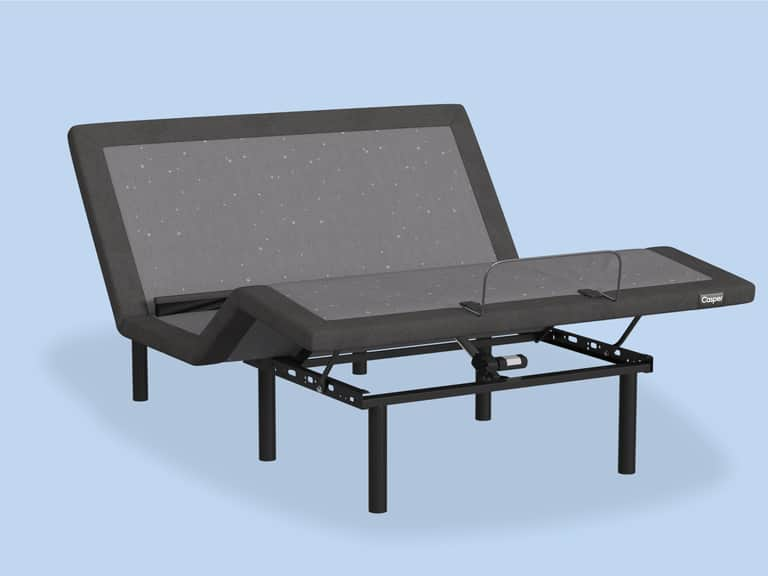
Some adjustable bases are intended to drop into existing bed frames, but the exact fit depends on the particular frame and size. The Casper Adjustable Base, for example, is described as designed to drop into most existing bed frames and can also be used as a standalone base with a headboard. Treat “most” as a starting point for a compatibility check, not a guarantee: compare measurements and confirm the intended setup with the relevant manufacturer or retailer.
Split systems require additional care. A split king, for instance, may consist of two separate bases and mattresses. Confirm the overall dimensions, whether the units need to move independently and how the bed frame accommodates the join. Think about access to controls and cables, as well as whether each side can adjust without contacting the other components.
A simple measurement checklist
Gather these details before placing an order. A few minutes with a tape measure and the mattress specification can prevent a poor fit or an unsuitable support arrangement.
- Finished bed height: Measure from the floor to the support surface, then add mattress and topper thickness.
- Current comfort reference: Note how easy it is to sit down, get up and reach the bedside table from your present bed.
- Room footprint: Check the frame’s outside dimensions and leave space for walking, drawers and bedding.
- Internal frame dimensions: Compare them with the mattress or adjustable base, not just the named size.
- Support specification: Verify slat spacing, deck type, centre rail and any mattress-maker requirements.
- Load guidance: Confirm the stated capacity and what it includes for the size you plan to buy.
- Clearance underneath: Measure around rails and centre legs if you intend to store items below the bed.
- Access and delivery: Check doorways, stairs, assembly space and the route to the bedroom.
- Compatibility documents: Read the frame and mattress instructions, and ask about any unresolved conditions.
Keep the measurements together rather than relying on memory. A small table in your notes can make it easier to compare two frames with different ways of presenting their dimensions. If figures seem inconsistent, ask the seller to identify the exact measurement points.
Common buying mistakes
Choosing by style alone. A beautiful frame can still be too high, too low or unsuitable for the mattress. Narrow the options using measurements and support requirements before deciding on finish and shape.
Assuming a platform needs no checks. “No box spring required” describes one aspect of the setup. It does not prove that the surface is compatible with every mattress. Check the mattress maker’s guidance and the frame’s construction.
Confusing clearance with bed height. The gap beneath the rail is not the height of the mattress-support surface. Find each figure separately and calculate the finished sleeping height.
Ignoring the centre of the frame. Side rails may look strong, while a missing or poorly supported centre section creates an issue on larger sizes. Look for the full support layout and follow the maker’s size-specific instructions.
Forgetting future changes. If you expect to change mattresses, add a topper or install an adjustable base later, check whether the chosen frame can accommodate that plan. Avoid buying on the assumption that future alterations will be straightforward.
Overlooking the warranty terms. Warranty coverage may depend on correct assembly, suitable support and use within stated limits. Keep product documentation and follow the maintenance instructions rather than assuming all failures are covered in the same way.
How to make the final choice
Start with the mattress. Its dimensions and support requirements define the conditions a frame must meet. Next, decide on a finished height that feels practical and looks balanced in the room. Then compare frame construction, weight guidance, clearance and assembly needs. Only after those checks should finish, headboard design and storage features settle the decision.
There is no single correct platform bed frame height. The right one is the height that suits the people using it, the mattress on top and the room around it. Nor is there one support design that suits every mattress. The useful choice is the one that meets the mattress maker’s requirements and provides stable, appropriately distributed support.
A platform frame can simplify a bedroom by combining structure and foundation in one design. That simplicity is earned through careful selection: measure the finished bed, inspect the support surface and verify compatibility before purchase. When those details line up, the frame does its quietest and most important job—supporting the mattress without becoming a daily problem.
At a glance
- Calculate the finished height from the floor to the support deck, plus mattress and topper.
- Check slat spacing or deck construction against the mattress manufacturer’s instructions.
- Compare internal dimensions, frame footprint and weight guidance before ordering.
- Assess centre support, under-bed clearance, assembly and delivery access.
- For an adjustable base, confirm that the bed frame allows the correct fit and full movement.